Overview
This year, I finally decided to take the prepper-plunge and turn my tax return into a whole-house battery storage system. I figured this ought to pay off for me one way or another. Since I live in a rural-ish area, we do lose power somewhat often during larger storms, and it takes longer to restore than the more dense areas of Silicon Valley. And PGE is on a tear, raising some rate or another every year and constantly changing the level of payoff from selling energy back to the grid (always in their favor, not mine!).
There were a lot of choices on the market: The traditional Tesla Powerwall is an option, but dealing with Tesla Solar customer support is an iffy proposition. My house has a preexisting Solar City roof and the deal to purchase the home almost fell through b/c the Tesla folks were very slow to record a transfer of ownership for the solar system itself.
There’s lots of new entrants too - the EcoFlow Max systems looked really attractive from a cost-benefit perspective and their app looks amazing - but my house has a weird two-panel (one upstairs, one downstairs) electric layout that makes isolating particular circuits for backup a huge nightmare. For this house, it’s whole-house-backup or nothing.
Finally I ended up reaching out to an electric installer in my area who does a lot of people’s generator setups and asking him if he does batteries too. He put me in touch with a guy named Jeff Beaman, at “Mountain Microgrids” and said they partner with Jeff for all battery backup and renewable power solutions.
Jeff is a prepper’s dream - this guy LOVES whole-house battery backup systems and is on a quest to build what he thinks is the perfect off-grid, disaster-resistant, cost-savings packages for all kinds of house setups. He’s also easy to work with, very communicative, and clearly knows his stuff. When the fire inspector came to inspect my final build, he seemed genuinely relieved and almost a bit shocked that Jeff had all the paperwork in order, including obscure fire-safety tests that many other installers overlook and have to be cited for. This isn’t a yelp review, but I’d be negligent if I didn’t point out that about 90% of this process is whether you get a good design/build/install or not, and I lucked out on getting an installer who is super into this stuff.
Below is what I ended up with, as designed by Jeff. Per Jeff, he has spec’d out primarily commercial-grade things; Sol-Ark’s primary market is large businesses wanting continuity, or small solar plant operators, for example.
My priorities were as follows:
- I want to maximize solar power self-consumption: the amount of my own solar that I use myself, because PGE pays peanuts for exported back-to-grid solar. (read up on NEM3)
- I want to maximize time-of-use shifting, again for cost reasons.
- I want enough capacity to last a couple days without having to involve a generator, because they’re noisy and disruptive.
- I absolutely DO want to be able to use a generator if needed, because power outages here can last 5 days or longer, and I want to be able to plan for a month if needed (earthquakes and wildfires, yo).
(Note: My desire to use a generator threw Tesla completely out of the running right away - my neighbor had a powerwall installed and not only did they tell him they cannot hook a generator into the powerwall, they made him remove the generator that was already in his yard. He sold it on Craigslist.)
My Solar/Battery/Grid setup:
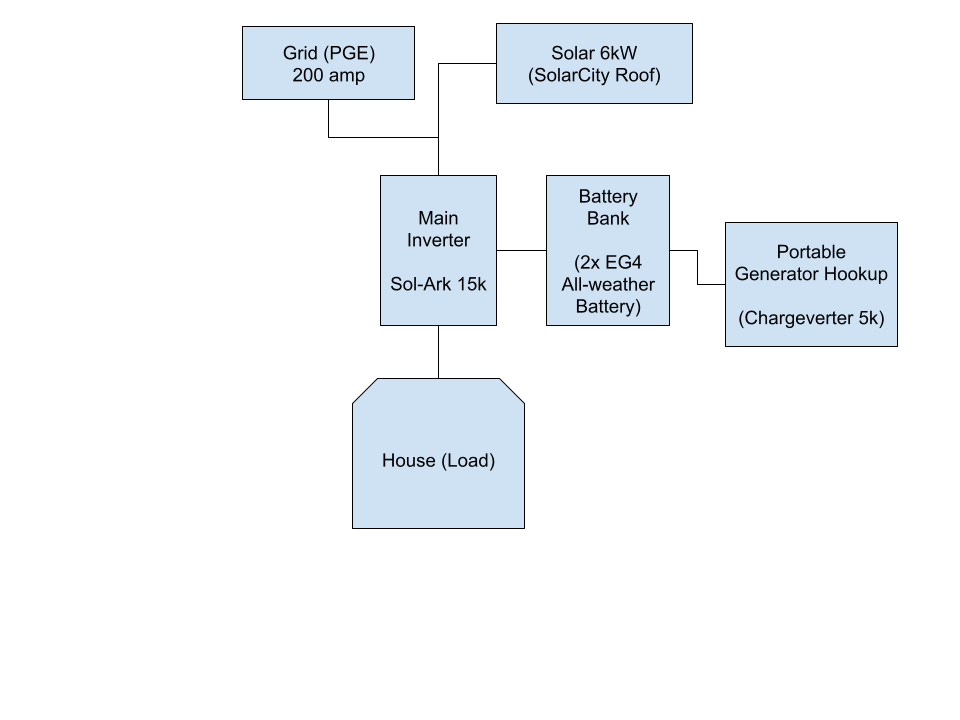
TLDR: A main inverter which shares the Grid, Solar, and Battery circuit to mix up to 15kW of stored or solar power into whatever the grid is offering based on Time of Use settings. You can choose to prioritize your own stored power over grid (which is what I’ve done) so it will stick to Solar and Battery power until you exceed your capacity, then add the grid in (see TOU settings, at the end).
When the grid goes down, the inverter runs fully off Solar and Battery. If the battery is low, a generator can be automatically engaged - but I’ve chosen to use a much cheaper manual generator hookup because the batteries should last me a couple days without needing the generator. Generator power directly recharges the batteries.
The Equipment:
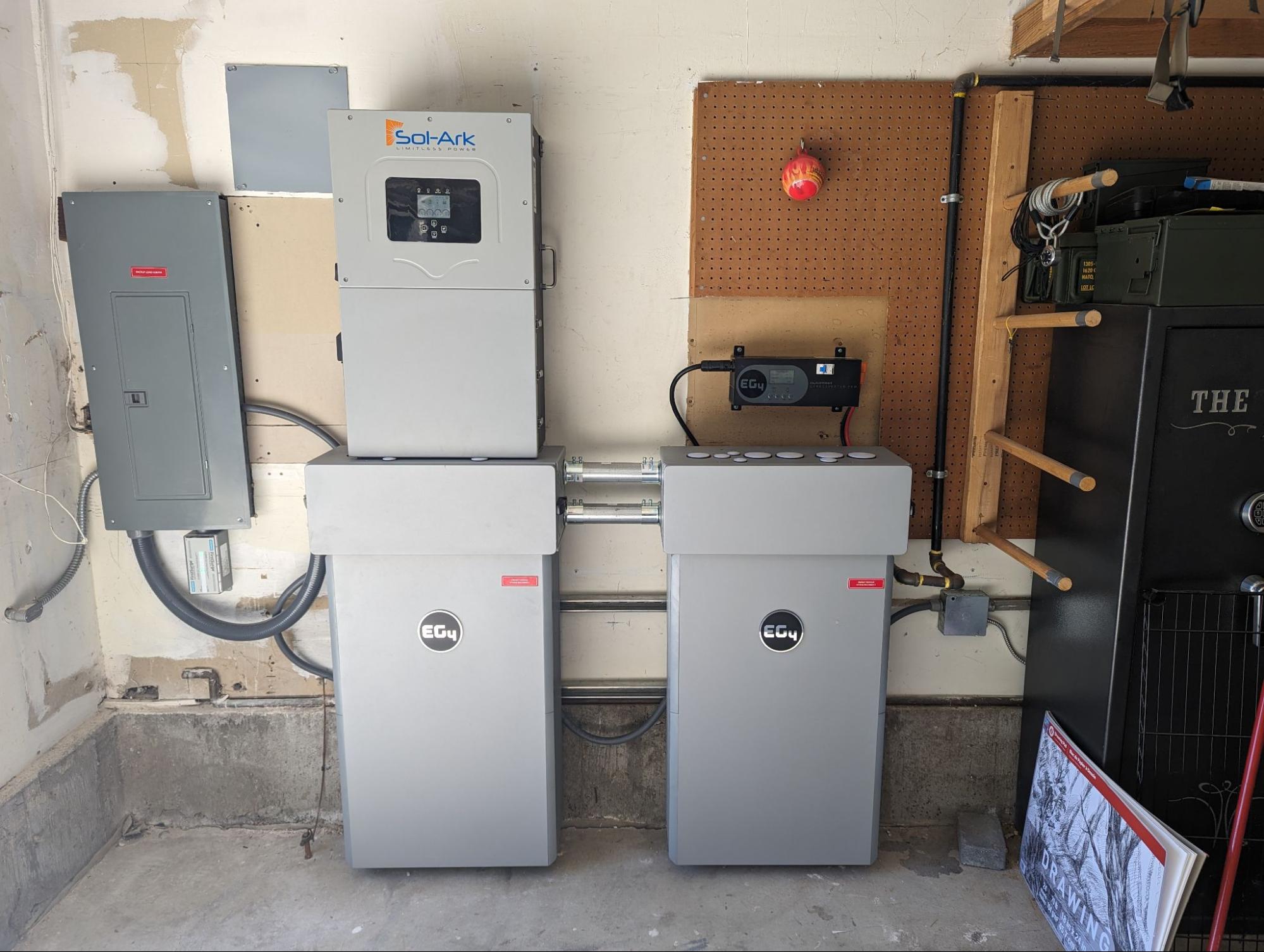
Inverter: Sol-Ark 15k
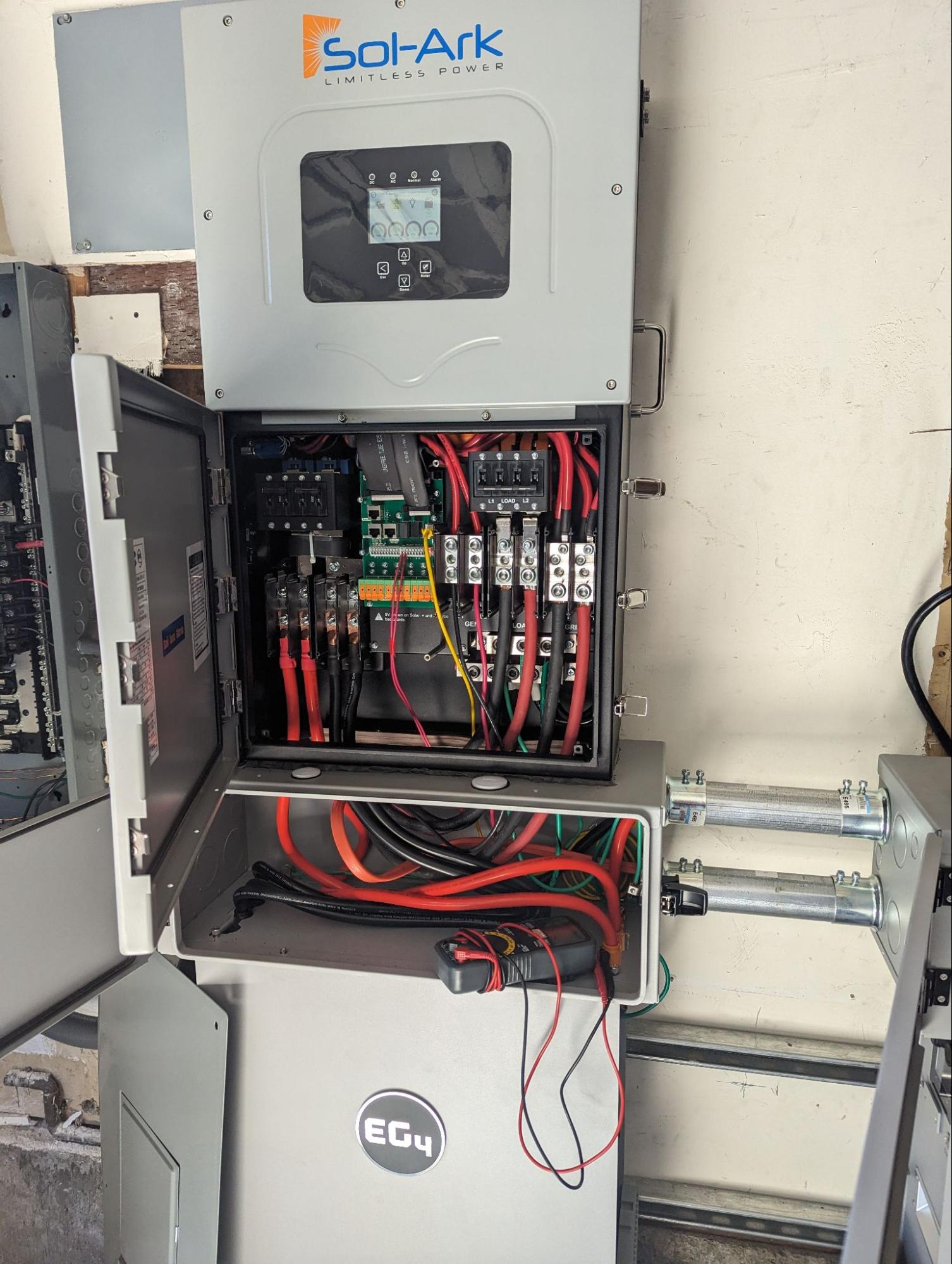
- All-in-one inverter which can direct-connect to Grid, Batteries, and Solar.
- Supports time-of-use settings and load mixing
- 4ms power outage cutover time (faster than CyberPower UPS!)
- Peak sustained Solar+Battery draw = 15KW
- Will mix Grid power into anything exceeding that draw
- Important (to me): The inverter has a real configuration panel on it; if the internet is gone or the cloud goes away you can still configure and operate it with the little touchscreen.
Batteries:
- EG4 Lithium-Iron Phosphate (LiFePO4)
- 2x 14KWh batteries (total 28KWh system)
- Design Life: > 15 years cycled daily (8000 deep cycles), 10 year manufacturers warranty
- UL9540A Certified (meets California safety standards), CEC California listed, and Integrated fire arrestors (EG4-LL v2)
- LiFePO4 batteries can charge to 100% without degrading the battery chemistry.
|
Damn that’s some pretty wiring |
Generator Hookup:
- EG4 Chargeverter
- Connects directly to 48v DC battery bank (not through inverter)
- Allows up to 5KW direct-charge of batteries from any external source
- I am using the Firman H07552 portable dual-fuel generator which I can manually attach to a generator port in the exterior of the house
|
|
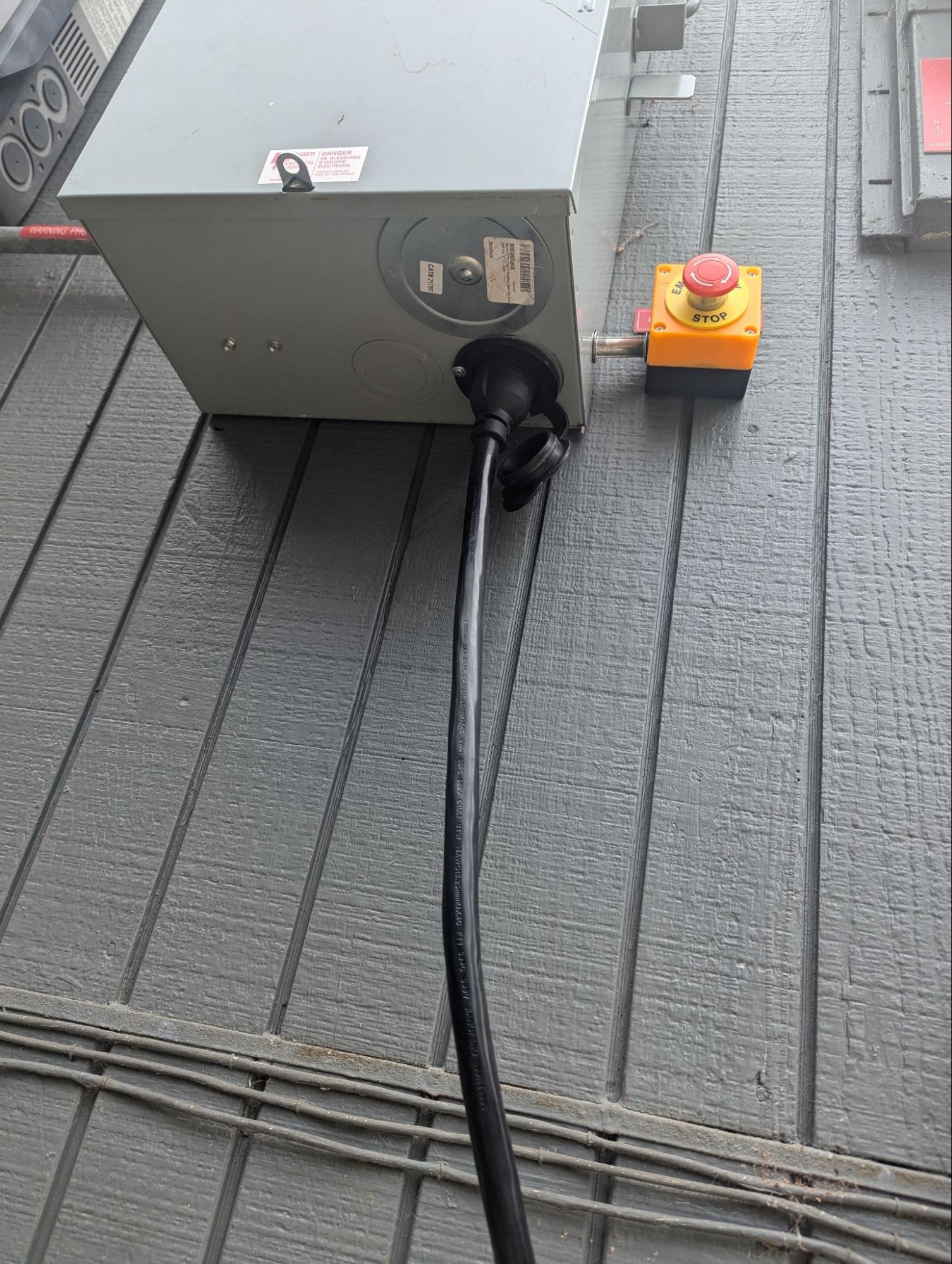
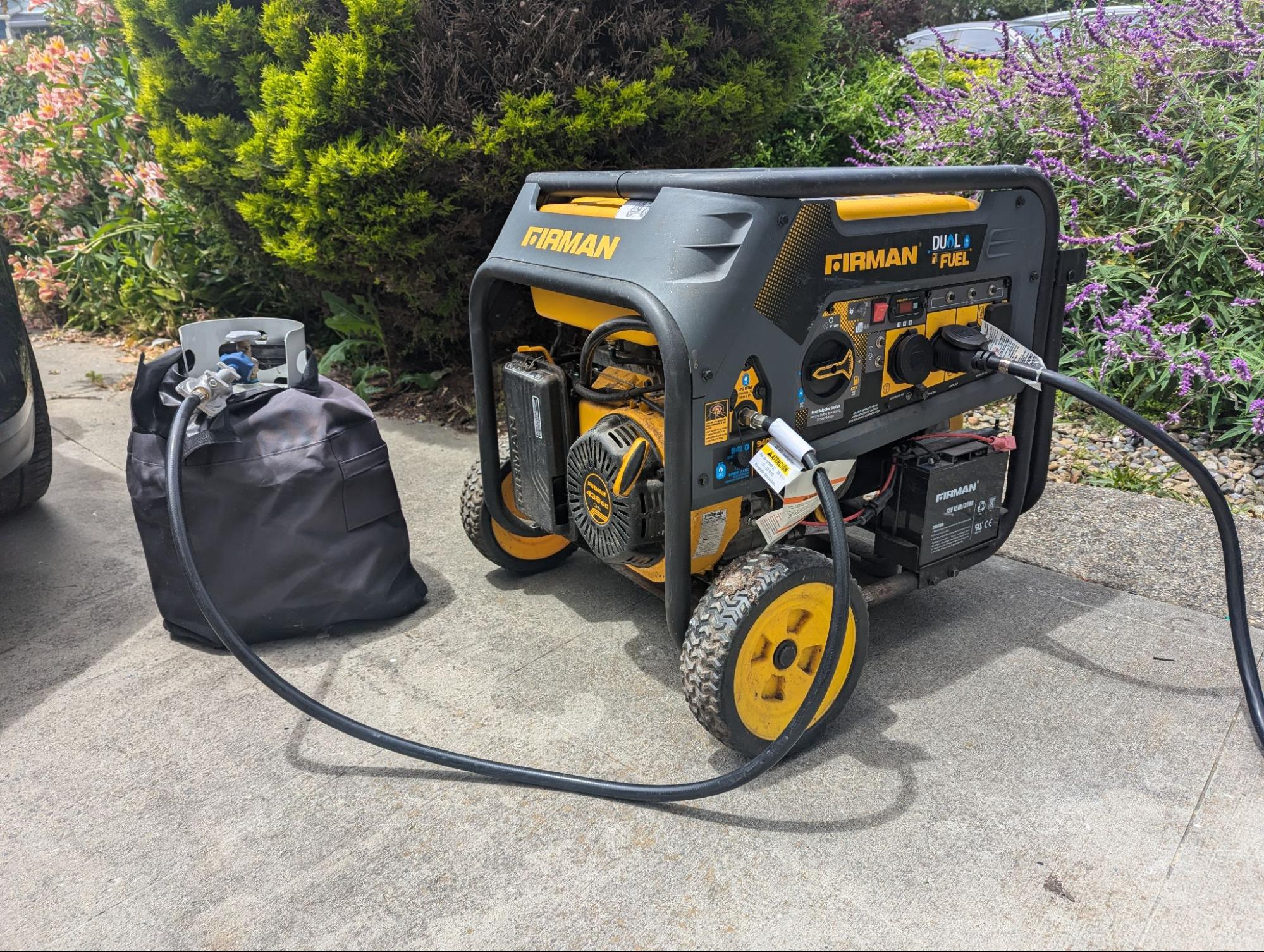
I’ve mentioned in other posts before that I prefer to use a medium-sized portable generator for disaster preparation vs installing a whole-home generator. There are a few reasons for this. First, it’s a LOT less expensive and for how often (i.e, very rarely) I truly need to drag it out the cost/benefit is more in my favor. But more importantly, it’s more flexible.
If I’m sheltering in place I can still use the generator but if my home is fine but the community is in need, I can also throw it in the back of a truck and take the fuel and generator to where the need is. This makes it into a CERT asset instead of purely a feature of my home.
Finally, I prefer dual-fuel generators which can run on gasoline if necessary but primarily use propane to fuel them. This lets me store more of a single fuel (Propane) for multiple purposes: Power generation, Heat (propane-powered heaters), and cooking (camp stoves). Propane also has the benefit of storing more safely in a residential area than large amounts of volatile gasoline, and its shelf life is much longer too.
Time of Use Settings:
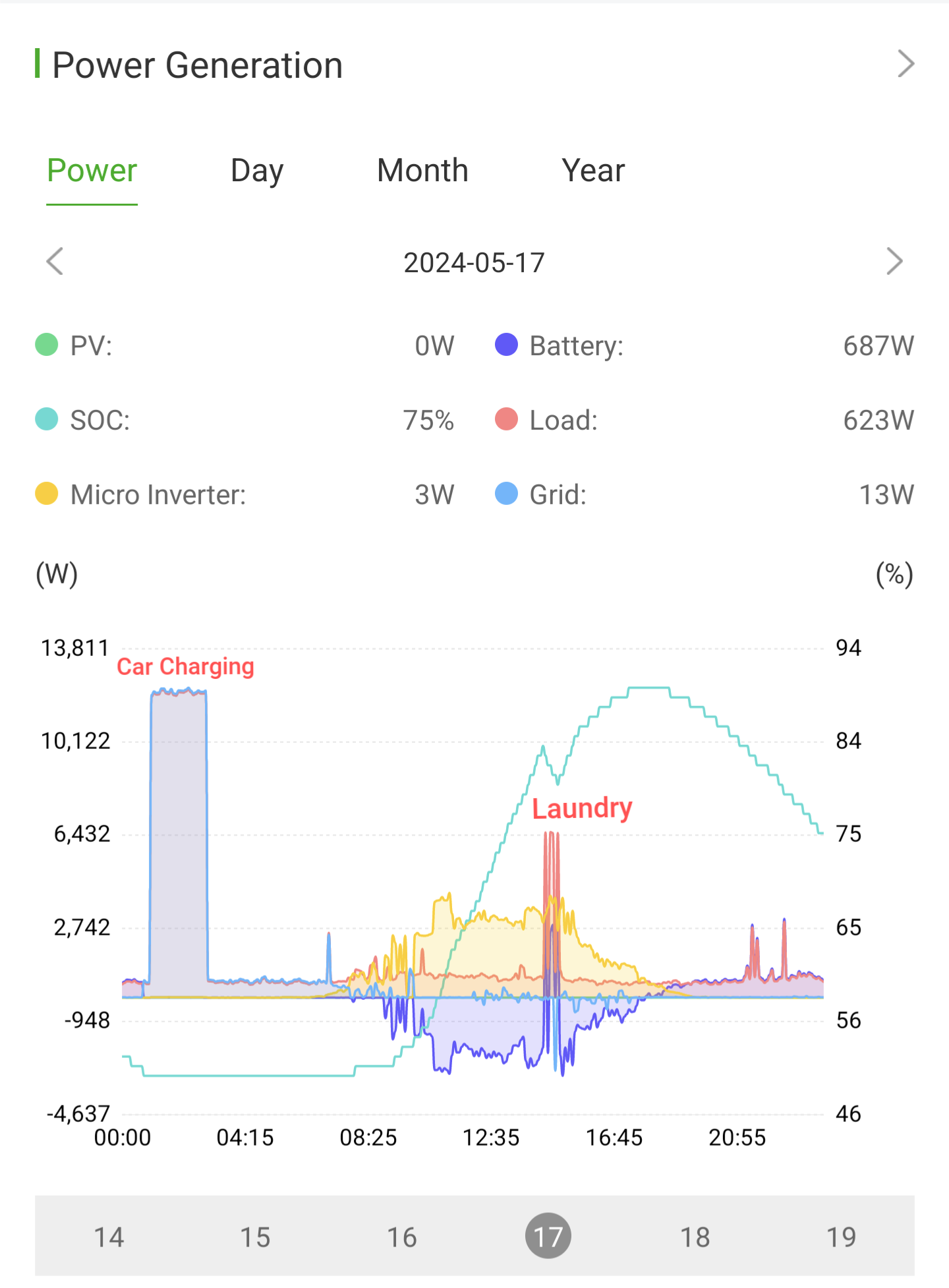
I’m using Time-of-Use to maximize cost savings from PGE and I’m willing to go pretty low on the battery. I know I can always top up the battery with a generator if an outage happens while the battery is low - so if a long grid outage happens while it is low, that’s no big deal.
I have the battery set to stop drawing any load at 20%, and to shut down if it hits 10% to save life for the battery management system and ensure all the components needed to charge it will remain alive for a long time.
Taken on a very cloudy day in May
ToU Legend:
- Time: The time period in which the ToU setting is valid. Must be in chronological order.
- Days: You can select which days the setting takes effect
- Elec. rate: The rate I pay at that time
- Charge Batt: If the battery is below the Min SOC setting, should it be charged up to that value?
- Max Batt Draw: The maximum draw allowed from battery before supplementing with grid power
- Min Batt SOC: Once the battery hits this level, stop pulling from it and use grid or other power
- Note: If the grid power is OFF, then “Time of Use” settings are all ignored and the “Minimum battery state” setting (20% for me) is where the battery stops drawing.
My Settings:
SUMMER (May -> September) | |||||||
Row | Days | Time | Elec Rate | Charge Batt? | Max Batt Draw | Min Batt SOC | Notes |
Time1 | All | 0:00 | 0.35 | Y | 1KW | 40 | Bring battery to minimum 40% charge from overnight low, using cheaper grid power |
Time2 | All | 1:00 | 0.35 | N | 1KW | 85 | Car charging time is 1am to 6am; extra charge if needed / laundry till noon. During this block, 1KW energy covers the normal house's needs but surges (e.g, car or laundry) come from cheaper grid power, not the battery |
Time3 | All | 6:00 | 0.35 | N | 2KW | 50 | 6am, Cars stop charging, use battery down to 50% so solar will charge it later but take surges (laundry, second car charge) off grid |
Time4 | All | 14:30 | 0.55 | N | 10KW | 35 | 3pm, higher rates kick in, use battery exclusively down to 35% |
Time5 | All | 16:00 | 0.66 | N | 10KW | 20 | 4pm, highest rates kick in, leverage battery as much as possible. |
Time6 | All | 21:00 | 0.55 | N | 10KW | 20 | 9pm to midnight, allow to go down to 20 if needed |
WINTER (October -> April) | |||||||
Row | Days | Time | Elec Rate | Charge Batt? | Max Batt Draw | Min SOC | Notes |
Time1 | All | 0:00 | 0.35 | Y | 1KW | 50 | Bring battery to minimum 50% charge from overnight low, using cheaper grid power |
Time2 | All | 2:00 | 0.35 | N | 1KW | 85 | Car charging time is 1am to 6am; extra charge if needed / laundry till noon. During this block, 1KW energy covers the normal house's needs but surges (e.g, car or laundry) come from cheaper grid power, not the battery |
Time3 | All | 12:00 | 0.35 | N | 2KW | 50 | 6am, Cars stop charging, use battery down to 50% so solar will charge it later but take surges (laundry, second car charge) off grid |
Time4 | All | 15:00 | 0.52 | N | 10KW | 35 | 3pm, higher rates kick in, use battery exclusively down to 35% |
Time5 | All | 16:00 | 0.54 | N | 10KW | 20 | 4pm, highest rates kick in, leverage battery as much as possible. |
Time6 | All | 21:00 | 0.52 | N | 10KW | 20 | 9pm to midnight, allow to go down to 20 if needed |
Surprises / Lessons Learned
Here’s some surprises and lessons learned from the install / use of the system so far.
- Sounds:
- The inverter and batteries make a constant (but relatively quiet) high pitched hum. This can be bothersome while I’m in the garage working on things. It’d probably be more bothersome if I was younger, I suspect this pitch is the kind I won’t even hear after I’m 50.
- When I have headphones on or earplugs (which is most of the time I’m doing any projects or workouts) I don’t hear it
- When I’m not paying attention it does sort of fade into the background even without headphones or earplugs
- Flickering LEDs:
- On the initial install of the system, we turned off the PGE breaker entirely to see what the house would be like when off-grid. I was surprised to find that some of the LEDs in my lights occasionally flicker in a bothersome way
- This turned out to not really be a problem - they don’t flicker when the grid is ON even if I’m not drawing grid power. They seem to only flicker when the grid is out AND the solar is outproducing the battery.
- Additionally, switching all the lights I can to Philips “Flicker-Free LED” bulbs seems to pretty much solve the problem
- Any remaining lights whose bulbs I can’t change (e.g, my Garage Door Opener built-in lighting) I will just not use if the grid is down.
- Generator:
- Having the generator charging the battery bank directly while theSolar is also producing ended up causing problems. The chargeverter detects voltage changes often and backs off the generator to 50%, which wastes fuel and takes longer to charge.
- The most fuel-efficient move is to wait until after the day’s solar production is done (or nearly done) then cut the solar off and let the chargeverter completely charge the battery at 100 DC amps. If it’s a bad solar day, then disconnect the DC solar power from the inverter at the breaker and charge instead.